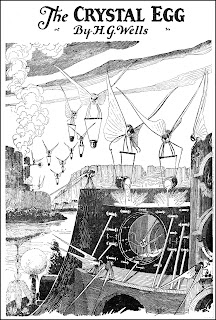
The Center for the Study of the Public Domain has released their annual Public Domain Day reminder about artistic works that could have entered the public domain on January 1, 2012. "Under the law that existed until 1978 . . . Works from 1955." That would have included such sf works as...
J.R.R. Tolkien’s The Return of the King, which would have made the entire Lord of Rings trilogy part of our common world heritage rather than the private property of the Tolkien estate.
Fredric Brown's sf comedy classic, Martians, Go Home.
Jack Finney's classic of Cold War paranoia, The Body Snatchers, which introduced the term "pod people" into the popular lexicon.
Leigh Brackett's post-holocaust classic, The Long Tomorrow.
Philip K. Dick's The Solar Lottery.
And Isaac Asimov's time travel novel, The End of Eternity, could along with his Foundation trilogy have entered the public domain.
Luckily there are some loopholes in the current restrictive laws. While stories like Robert Sheckley's humorous "The Lifeboat Mutiny" (1955) is not in the public domain, the X Minus One radio adaptation of it is. So until the law is repaired we can at least freely enjoy it in that form.
The Lifeboat Mutiny
Showing posts with label science fiction. Show all posts
Monday, January 2, 2012
Wednesday, December 28, 2011
Rusty Hevelin (1922-2011)
Longtime sf fan Rusty Hevelin has passed away. If you ever attended an sf con you know who Rusty was. He was a fixture of fandom and his passing will be deeply felt by all. The first memory I have of him is of him sitting on a panel discussing noteworthy sf novels, and me taking mental notes for future reference. Goodbye, Rusty. We'll miss you.
Sunday, December 11, 2011
Here Comes Gojira Claus
There's nothing like a giant, radioactive theropod rampaging through a shopping mall to get you into the holiday spirit, is there?
[via Disinfo]
Wednesday, November 16, 2011
Side Effects of 6 Fictional Drugs
Since at least the days of H. G. Wells' "The New Accelerator", sf has been prescribing fictional pharmaceuticals for literary purposes. Cordrazine, kalocin, kerasine - just of few of the many imaginary medicines that can have undesirable side effects. Gabe Habash of Publishers Weekly gives a rundown of 6 Fictional Drugs with Unintended Side Effects.
[via Disinfo]
Tuesday, September 13, 2011
Voyage Trekkers
There's no shortage of Star Trek parodies out there, but this one is funnier than most. Squishy Studios' Voyage Trekkers follows the misadventures of Capt. Jack T. Sunstrike and the crew of the G.S.V. Remarkable as they explore strange new worlds and all that. The first season is set to run for ten episodes, and I'm keeping my fingers crossed for a season two.
"Is it wrong that I can't tell them apart?"
"At least it's not another stupid Cowboy Planet."
"Is it wrong that I can't tell them apart?"
"At least it's not another stupid Cowboy Planet."
Friday, August 19, 2011
Monday, July 11, 2011
Then & Now
Art by Frank R. Paul
Heli-ship then...
Art by Jack Kirby
...heli-ship now.
Images via GACBS and Superpouvoir.
Thursday, July 7, 2011
The Monarch of the Rings
I was paging through Everett F. Bleiler's Science Fiction: The Early Years when I came across a story description that caught my eye. It's Paul Ernst's novel The Black Monarch which was serialized in five parts in Weird Tales in Feb.-June 1930.
The story involves an evil overlord who uses rings to control the wills of others in an attempt to conquer the world. What struck me about the story is how similar the main plot strand is to Tolkien's later fantasy, The Lord of the Rings. Unfortunately the novel has never been reprinted. And since there are no scanlations of these issues available, and since the actual copies of Weird Tales can run $100 each, I've never read it. So I have to rely on Bleiler's summary, which goes like this...
In addition to sounding like the plot of any number of comic book stories - just add leotard clad vigilantes and stir - and like the template for Richard Shaver's entire output, it's also surprisingly similar to the main plot of The Lord of the Rings. Since it's extremely improbable that Tolkien ever heard of this novel, let alone read it, I'm sure this is just a strange coincidence. But I find it fascinating that years before anyone had heard of Hobbits or Middle-earth there was a dark lord seeking world domination through the agency of the rings he controlled.
"We've got to stop meeting like this."
The story involves an evil overlord who uses rings to control the wills of others in an attempt to conquer the world. What struck me about the story is how similar the main plot strand is to Tolkien's later fantasy, The Lord of the Rings. Unfortunately the novel has never been reprinted. And since there are no scanlations of these issues available, and since the actual copies of Weird Tales can run $100 each, I've never read it. So I have to rely on Bleiler's summary, which goes like this...
Novel. World peril, a criminal mastermind, and a kitchen sink full of oddities. * 1992, mostly Algeria. * Neil Emory awakens from a somnambulistic episode to find himself partly through the porthole of his ocean-liner cabin. The attempt seems to be linked with an antique ring set with a blue diamond that he is wearing. Not long after this Emory sees another man (Dr. Eden Sanderson) go through the same actions. He, too, was wearing a ring like Emory's which he then discarded. * Sanderson tells a strange story: His foster-father, an inventor, after creating a machine that responded to thoughts waves, attuned it to locate evil. He found one enormous focal point, but before he could isolate it, a stranger visited him, leaving a ring, and after that the invention did not work. But the ring shows images of a gigantic man with a metal arrangement over his head. * Sanderson's foster-father reared Sanderson to be a champion against the evil being, and Sanderson invites Emory to join the quest, which centers on Algeria. * For a time the men search unsuccessfully, until a landslide reveals a tunnel leading to an underground world illuminated by golden plates. The land is inhabited by small, robot-like men. After separate adventures, Sanderson and Emory are captured and are taken before Rez, an enormous man with a metal head who rules the underworld. * Rez (who resembles H. Rider Haggard's Ru in She and Allen) is an ancient Egyptian more than six thousand years old. He wears a metal case to accommodate his enlarged brain. The master of an incredible science, he has very highly developed paranormal powers, conversing by telepathy and controlling the wills of others through a diamond crystal a dozen feet across. Fragments of this crystal, set in rings, are distributed around the world, and through them Rez controls his victims. Rez has fostered wars, greed, cruelty and crime, and is about to push the world into a war that will end civilization, after which he will emerge and take over. * Actually, he summoned Sanderson and Emory and caused the landslide which admitted them. His purpose: He needs surface men on whom to test his mind drugs and mental surgery. The two men resist, but the great crystal easily overpowers them. Rez's drug them turns Emory into a zombie-like being with no memory of the past. * The situation seems hopeless, but Sanderson conditions the nearly mindless Emory into smashing the diamond and then bests Rez in mortal combat. Neil, led by a surface woman they met below, escapes, but Sanderson dies holding back the zombie-like guards. Outside, Emory gradually regains his mind.
In addition to sounding like the plot of any number of comic book stories - just add leotard clad vigilantes and stir - and like the template for Richard Shaver's entire output, it's also surprisingly similar to the main plot of The Lord of the Rings. Since it's extremely improbable that Tolkien ever heard of this novel, let alone read it, I'm sure this is just a strange coincidence. But I find it fascinating that years before anyone had heard of Hobbits or Middle-earth there was a dark lord seeking world domination through the agency of the rings he controlled.
Monday, July 4, 2011
Independence Day
The cornerstone of the Washington Monument was laid as part of an elaborate Fourth of July ceremony hosted by the Freemasons - so who knows? Maybe it does hide a death-ray.
Wednesday, June 22, 2011
Science Fiction League
The other day some great scans of Science Fiction League ephemera were posted over at Golden Age Comic Book Stories. While the Science Fiction League wasn't the first sf fan club, it was very important in the history of fandom. The story of its creation was related by Everett F. Bleiler in his study, Science-Fiction: The Gernsback Years (1998).
"Gernsback's most visible promotion device was the creation of the Science Fiction League, a quasi-fraternal national organization of science-fiction fans set up in local chapters. In later issues of the magazine [Wonder Stories] several pages were devoted to inspirational material about the league, chapter publicity, and similar matters. There were no dues, but paraphernalia was available from Gernsback - buttons, insignia, stationary, and other matters, on all of which Gernsback undoubtedly turned a profit. At an earlier date Gernsback had operated a similar club through his technical magazines."
"Gernsback's Science Fiction League seems to have peaked at about a thousand members while Wonder Stories was in existence. While it was directly and indirectly profitable to Gernsback, it also accomplished a fair amount in organizing science-fiction fandom, which had hitherto been sporadic and individual. Such organization had mixed results. On the one hand, it helped create an "esprit d'âme," if such a term be permitted; on the other hand it opened the way to the intense factionalism that has long been characteristic of science-fiction fandom."
Wednesday, March 23, 2011
Amazing Stories #2
"In the late 1920s and early 1930s a new literary phenomenon came into being in the United States. This was genre science-fiction, recognized as such and sold as such in between forty and fifty thousand newsstands, drugstores and tobacconists. Although American in origin, it had in part an international ancestry, what with the earlier science-fictions of Jules Verne, H. G. Wells and others. But as it now developed, it was something new." E. F. Bleiler, Science-fiction: The Gernsback Years
"At a convention of astronomers, it is proposed that a great new telescope be constructed. It would use a "mercury mirror" along with an "ether beam" to destroy matter which might inhibit the transmission of light through the atmostphere. While exploring with the telescope after its construction, the scientists discover a nearly identical setup on Mars."
"Kirby lands on an Earth-like planet, where he is picked up and imprisoned with a beautiful female genius named Vinda. Kirby wants to return to Earth, but can't find it, so Vinda's uncle explains how he can at least find an alternative Earth. He finally returns, taking Vinda with him, to a slightly different Earth."
[Images via Golden Age Comic Book Stories, summaries via The Internet Speculative Fiction Database]
"At a convention of astronomers, it is proposed that a great new telescope be constructed. It would use a "mercury mirror" along with an "ether beam" to destroy matter which might inhibit the transmission of light through the atmostphere. While exploring with the telescope after its construction, the scientists discover a nearly identical setup on Mars."
"Kirby lands on an Earth-like planet, where he is picked up and imprisoned with a beautiful female genius named Vinda. Kirby wants to return to Earth, but can't find it, so Vinda's uncle explains how he can at least find an alternative Earth. He finally returns, taking Vinda with him, to a slightly different Earth."
[Images via Golden Age Comic Book Stories, summaries via The Internet Speculative Fiction Database]
Tuesday, March 22, 2011
Irradiated Zone
Tom Engelhardt has an interesting article on his site today. "Irradiated Zone: Don’t Go There! Missing in the Japan Catastrophe -- Thinking the Unthinkable" considers the nuclear crisis in Japan through his youthful memories of reading Walter M. Miller, Jr.'s sf classic A Canticle for Leibowitz (1955).
It's a natural comparison for someone raised in those days to make, although to be fair there's a big difference between a meltdown and the global thermonuclear war depicted in those books. Lester del Rey's Nerves (1956, revised 1976) which involves "atomjacks" fighting to avert a catastrophe at an atomic power plant might be a more apt reference, although it obviously isn't widely known. When it comes to the aftermath of such a crisis, the book that sprang to my mind was Michael Swanwick's In the Drift (1985) which depicts just the kind of irradiated exclusion zone we all fear might result if worse comes to worse.
Canticle, like many novels of its era, was set in a new dark age after humans had destroyed so many of their own and so much of their civilization, leaving behind a mutant planet. It didn’t take a lot of smarts to know how they did that either: with the newly discovered power of the atom -- already loosed on the perfectly real cities of Hiroshima and Nagasaki -- aided and abetted by the hubris and bumbling of humanity. (I hope, given the headlines of the moment, you see where I’m heading.)
It's a natural comparison for someone raised in those days to make, although to be fair there's a big difference between a meltdown and the global thermonuclear war depicted in those books. Lester del Rey's Nerves (1956, revised 1976) which involves "atomjacks" fighting to avert a catastrophe at an atomic power plant might be a more apt reference, although it obviously isn't widely known. When it comes to the aftermath of such a crisis, the book that sprang to my mind was Michael Swanwick's In the Drift (1985) which depicts just the kind of irradiated exclusion zone we all fear might result if worse comes to worse.
Friday, March 18, 2011
Amazing Stories #1
"The first issue of the first science-fiction magazine, Amazing Stories, published by Hugo Gernsback, a New York inventor and publisher of technical magazines, appeared on the stands and presumably arrived in the mail for subscriptions around the first week of March 1926. Within a little more than ten years, Amazing Stories and its later rivals numbered 345 issues..." E. F. Bleiler, Science-fiction: The Gernsback Years
"Professor Martyn invents a box that allows one to increase or decrease one's size. Kirby, wearing the device, makes himself increasingly larger, until he is larger than the universe. At his point he cannot easily shrink himself and still find the Earth, so he settles for a planet somewhat like Earth."
"While vacationing in Labrador, something begins to kill off the party - something which burns patterns into everything in its path, including rock."
"Strange globes of force appear across the world, removing chunks of land and ocean. The globes were sent by Martians, who are trying to steal Earth's water resources. The man who saves the Earth is Charles Huyck, who figures out how to disable the globes."
[Images via Golden Age Comic Book Stories, summaries via The Internet Speculative Fiction Database]
"Professor Martyn invents a box that allows one to increase or decrease one's size. Kirby, wearing the device, makes himself increasingly larger, until he is larger than the universe. At his point he cannot easily shrink himself and still find the Earth, so he settles for a planet somewhat like Earth."
"While vacationing in Labrador, something begins to kill off the party - something which burns patterns into everything in its path, including rock."
"Strange globes of force appear across the world, removing chunks of land and ocean. The globes were sent by Martians, who are trying to steal Earth's water resources. The man who saves the Earth is Charles Huyck, who figures out how to disable the globes."
[Images via Golden Age Comic Book Stories, summaries via The Internet Speculative Fiction Database]
Wednesday, March 9, 2011
Monday, February 21, 2011
The dawn of Dianetics
With the recent New Yorker exposé of Scientology and the news that the FBI is investigating the church over allegations of human trafficking, it's hard to remember those more innocent (naïve?) times when it was first unleashed on an unsuspecting world in the pages of a science fiction magazine. It was in John W. Campbell, Jr's Astounding Science Fiction, May 1950, that sf author L. Ron Hubbard's essay "Dianetics: The Evolution of a Science" first appeared, followed quickly by his book, Dianetics: The Modern Science of Mental Health.
This relatively innocuous D.I.Y. pop-psychology book was the nucleus of what would later become the religion of Scientology. Although the book failed to impress practicing psychologists such as Eric Fromm, who observed that "Hubbard's book can hardly be taken seriously as a scientific contribution...", it appealed to others, notably William S. Burroughs. It also struck a cord among several sf authors, such as Campbell, James Blish, and A. E. Van Vogt, who ran a Dianetics Center in L.A. for years. And while many of those early adherents quickly became disillusioned with the new religion the initial enthusiasm felt by some can be glimpsed in this review of the book by Blish for Planet Stories.
Dianetics: A Door to the Future
By James Blish
An increased life-span, freedom from 70% of all human illnesses and a major increase in intelligence - these are only a few of the benefits promised us by a new science called "dianetics."
"Dianetics" is both the name of a recent book about how the human mind operates, and the general term used to cover specific methods of repairing, healing and perfecting the human mind.
Monday, February 14, 2011
Wednesday, February 9, 2011
Friday, February 4, 2011
Wednesday, February 2, 2011
Thursday, January 20, 2011
More Sex in the Future?
This thoughtful letter to the editor is from Planet Stories (Summer, 1949) of all places, which is kind of surprising given that it has the reputation of being the least serious of the old pulps. It would be decades before the New Wave broke and this fans hopes were realized.
New Brunswick, N. J.
Dear Editor:
These letters squawking emotionally against the inclusion of sex in science-fiction stories leave me disappointed, disturbed and more than a little disgusted. They seem to be the work of inhibited, repressed personalities. I am not placing myself in the position of endorsing smut or pornography, but I believe the subject of sex deserves some straightforward, adult handling.
If science- fiction has anything to offer other than mere escapism, its value lies in promoting a receptive, questioning attitude and freeing the mind from the narrow, superstition-bound, taboo-ridden ruts of accustomed thought channels.
Nearly every science-fiction story is a glimpse into some writer's conception of a possible future, and as change is the one certainty in this universe, the future will be different from the present. How different? Our present-day patterns are neither perfect nor static. Some of our better brains have concluded that if we don't rapidly learn as much about our own psychology and social structures as we already know about the guts of a uranium atom, we are heading for disaster on a grand scale.
Anyone not entirely prejudice-blinded can see that the conventional standards of sex conduct of today are irrational, hypocritical, and simply are not working. The Kinsey report indicates clearly that a socially dangerous schizoid gap exists between "moral principles" and actual conduct.
Our self-appointed "moral leaders" have decreed certain rules, to which everyone is supposed to adhere unquestioningly on blind faith alone. And they insist in the face of contrary evidence that these rules are eternal and immutable and unchanging. They carefully ignore the fact that other civilizations have done as well or better than our own in promoting human welfare, using an entirely different set of standards of conduct.
Polygamy has been successful in many places, until our own civilization intervened with superior military and police forces. (And the present Hollywood concept of marriage is nothing but legalized serial polygamy.) Many cultures, those of Crete and Athens and Bali, for instance, accepted costumes which left female breasts fully exposed and yet have not lapsed into unbridled lewdness. Many civilizations have experimented, some quite successfully, with premarital and extra-marital sexual freedom.
And, if our own civilization doesn't radioactivate itself into oblivion or sterility, increasing biological knowledge will surely give us complete control of reproduction. Children will be born only when they are definitely desired. That too will alter the social patterns.
Sex will probably remain one of the basic human drives as long as homo sapiens is recognizable as such. So let's quit trying to hide that fact beneath a mound of taboos. Whether the authors see the future patterns as puritanism or libertinism, monogamy or polygamy or polyandry or eugenic mating controlled by bureaucrats, that
makes little difference. To each author his own dreams. But a writer can't very well depict the social structure of a hypothetical future world without including man-woman relationships — and in these sex will be a basic factor.
So I contend that discussions of sex have just as legitimate a place in science-fiction as nuclear physics and military technology and synthetic foods and the eternal struggle of dictatorship vs. freedom. If science-fiction can persuade people to look openmindedly at themselves and their emotion-dominated attitudes, it can do us all a great service.
So let's start jettisoning the taboos!
Sincerely,
John Higgins
[via Gerard Arthus & The Internet Archive]
New Brunswick, N. J.
Dear Editor:
These letters squawking emotionally against the inclusion of sex in science-fiction stories leave me disappointed, disturbed and more than a little disgusted. They seem to be the work of inhibited, repressed personalities. I am not placing myself in the position of endorsing smut or pornography, but I believe the subject of sex deserves some straightforward, adult handling.
If science- fiction has anything to offer other than mere escapism, its value lies in promoting a receptive, questioning attitude and freeing the mind from the narrow, superstition-bound, taboo-ridden ruts of accustomed thought channels.
Nearly every science-fiction story is a glimpse into some writer's conception of a possible future, and as change is the one certainty in this universe, the future will be different from the present. How different? Our present-day patterns are neither perfect nor static. Some of our better brains have concluded that if we don't rapidly learn as much about our own psychology and social structures as we already know about the guts of a uranium atom, we are heading for disaster on a grand scale.
Anyone not entirely prejudice-blinded can see that the conventional standards of sex conduct of today are irrational, hypocritical, and simply are not working. The Kinsey report indicates clearly that a socially dangerous schizoid gap exists between "moral principles" and actual conduct.
Our self-appointed "moral leaders" have decreed certain rules, to which everyone is supposed to adhere unquestioningly on blind faith alone. And they insist in the face of contrary evidence that these rules are eternal and immutable and unchanging. They carefully ignore the fact that other civilizations have done as well or better than our own in promoting human welfare, using an entirely different set of standards of conduct.
Polygamy has been successful in many places, until our own civilization intervened with superior military and police forces. (And the present Hollywood concept of marriage is nothing but legalized serial polygamy.) Many cultures, those of Crete and Athens and Bali, for instance, accepted costumes which left female breasts fully exposed and yet have not lapsed into unbridled lewdness. Many civilizations have experimented, some quite successfully, with premarital and extra-marital sexual freedom.
And, if our own civilization doesn't radioactivate itself into oblivion or sterility, increasing biological knowledge will surely give us complete control of reproduction. Children will be born only when they are definitely desired. That too will alter the social patterns.
Sex will probably remain one of the basic human drives as long as homo sapiens is recognizable as such. So let's quit trying to hide that fact beneath a mound of taboos. Whether the authors see the future patterns as puritanism or libertinism, monogamy or polygamy or polyandry or eugenic mating controlled by bureaucrats, that
makes little difference. To each author his own dreams. But a writer can't very well depict the social structure of a hypothetical future world without including man-woman relationships — and in these sex will be a basic factor.
So I contend that discussions of sex have just as legitimate a place in science-fiction as nuclear physics and military technology and synthetic foods and the eternal struggle of dictatorship vs. freedom. If science-fiction can persuade people to look openmindedly at themselves and their emotion-dominated attitudes, it can do us all a great service.
So let's start jettisoning the taboos!
Sincerely,
John Higgins
[via Gerard Arthus & The Internet Archive]
Subscribe to:
Posts (Atom)