Showing posts with label sf book review. Show all posts

Wednesday, June 29, 2011

Dinosaur Beach (1971)

Yesterday's near-miss between the ISS and a piece of space garbage reminded me of Keith Laumer's 1971 time travel novel Dinosaur Beach. Why would a whizzing piece of space rubbish make me think of time travel? Read on...


The novel centers around Igor Ravel, a time traveling agent of Nexx Central. He is part of Project Timesweep, a Fourth Era attempt to undo the temporal tampering of previous eras. Implanted with a false identity, he's on a deep-cover mission in 1936. Thinking himself a happy newlywed, a post-hypnotic suggestion triggers him to remember his mission and leave his young wife, Lisa. Before you can say "Jack Robinson," (which they did back in the 1930's) he's used his Mauser to gun down a Karg, a time traveling robot from an earlier era. Retrieving the tape from the Karg he time jumps back to Dinosaur Beach, a Nexx Staging Station located in the prehistoric past. After a cursory debriefing, but before he can be mind-wiped and have his implanted personality and love of Lisa erased, the station is attacked and destroyed. Ravel is the lone survivor, and he takes drastic action. He activates the personal emergency jump gear installed in his body in the hopes of reaching another station. This begins his desperate odyssey through time which leads him to again encounter his lover, Lisa, who claims to actually be Mellia Gayl, a fellow Timesweep agent. They must do all they can to escape being "marooned in the closed loop of an unrealized alternate reality."

What made me think of this book when I heard about the Space Station's near miss is the passage describing the raison d'ĂȘtre of Project Timesweep.

"The idea wasn't without logic. The First Era of time travel had closely resembled the dawn of the space age in some ways—notably, in the trail of rubbish it left behind. In the case of the space garbage, it had taken half a dozen major collisions to convince the early space authorities of the need to sweep circumterrestrial space clean of fifty years debris in the form of spent rocket casings, defunct telemetry gear, and derelict relay satellites long lost track of. In the process they'd turned up a surprising number of odds and ends, including lumps of meteoric rock and iron, chondrites of clearly earthly origin, possibly volcanic, the mummified body of an astronaut lost on an early space walk, and a number of artifacts that the authorities of the day had scratched their heads over and finally written off as the equivalent of empty beer cans tossed out by visitors from out-system.

That was long before the days of Timecasting, of course.

The Timesweep program was a close parallel to the space sweep. The Old Era temporal experimenters had littered the timeways with everything from early one-way timecans to observation stations, dead bodies, abandoned instruments, weapons and equipment of all sorts, including an automatic mining setup established under the Antarctic icecap which caused headaches at the time of the Big Melt."

This short book succeeds in delivering a briskly paced sf thriller with plenty of plot twists and a dash of romance. The prose is terse and no-nonsense, written in a style reminiscent of hard-boiled detective novels. It's as if Dashiell Hammett had written a novel after the fashion of Jack Williamson's The Legion of Time (1938). If the book has a short coming it's that the trajectory of the plot is too similar to Laumer's earlier work, A Plague of Demons (1965). Like the protagonist of that previous book, Ravel is somewhat hyper-competent, discovering new, hidden superpowers as the occasion demands. And there are a few plot holes, but nothing that seriously distracts from the kinetic plot. While this isn't an ambitious novel, and can't be compared to books like Isaac Asimov's The End of Eternity (1955) or Fritz Leiber's The Big Time (1958), it does call into question the assumptions that underlie most "time police" stories.

This is a two-fisted tale of sf adventure with plenty of surprises along the way and an unexpected ending. It's a great book to breeze through on a lazy summer afternoon. Just watch out for the time junk.

Wednesday, June 1, 2011

All the Lives He Led (2011)

In a postscript to his 1957 novel Slave Ship (which in a way anticipated the Vietnam War), Frederik Pohl explained what it is that science fiction writers do.

"It is not the business of the science fiction writer to record matters of contemporary fact or scientific truths that have already been discovered. It his business to take what is already known and, by extrapolating from it, draw as plausibly detailed a portrait as he can manage of what tomorrow's scientists may learn...and what the human race in its day-to-day life may make of it all."

In his latest novel, All the Lives He Led (2011), he stays true to his own definition and delivers an entertaining and disquieting vision of a possible near-future.


The book is a first-person account, a memoir of sorts, by Brad Sheridan. Once the scion of an upper-class Midwestern family, Brad's fortunes took a turn for the worse thanks to a natural catastrophe. In the 2060's Yellowstone National Park, famous for it's geysers, decided it was tired of lying dormant. The resulting supervolcano laid waste to the better part of the USA and crippled the national and world economy, forever ending America's days as a Superpower. Brad and his family find themselves scraping out a meager existence in the Molly Pitcher Redeployment Village on Staten Island. Brad spends his day being bullied by the local New York youths and running two-bit hustles, like rolling drunk tourists. His life is further complicated by the black sheep of the family, the Reverend Delmore DeVries Maddingsley. Uncle Devious, as his relatives know him, ran a scam charity funneling money to terrorists, bringing suspicion on the entire family. Eventually Brad takes the only avenue open to someone in his dire straights. He becomes an indentured servant. This eventually leads him, via airship, to Italy where he gets a job working at L'Annio Giubileo della Citta di Pompeii, or the Pompeii Jubilee. This is an elaborate celebration which involves the use of holographic virtual reality, or "virts", to recreate the ancient city of Pompeii. But insubstantial holograms can't sell tourists souvenirs, and so Brad, after some minor misadventures, finds himself vending wine and hydromel to sightseers from a cramped stall on the Via dell'Abbondanza. Security is tight at this major world event. Despite some unwelcome heat from Security, in the person of the un-personable "Piranha Woman," as a result of his relation to Uncle Devious, Brad seems to be doing alright. He attends the mandatory Security meetings about the numerous terrorist groups that bedevil society. His boss, known to his employees as "the Welsh Bastard," is gruff but not unbearable. He's making some casual friends, like the attractive Elfreda Barcowicz and the emotionally needy Maury Tesch. And when he gets romantically involved with Gerda Flemming things really start looking up. But his friends aren't all they seem. And a mysterious disease, dubbed "the Pompeii Flu," starts to spread. Then Brad finds himself approached by the wealthy Eustace Chi-Leong to smuggle a stolen antiquity aboard the luxury cruise zeppelin Chang Jang. And before he knows it, Brad is in over his head in a dangerous situation not of his making.

This is a grimly plausible novel. The future it portrays is one that could easily come to pass. The setting of the Giubileo, of a virtual world superimposed on an ancient city, becomes a metaphor for the exploration of transformed identity. It is through this city experiencing a duel existence that Brad must undertake his existential journey. The simulated surface of Pompeii is reflected in the misrepresentations of the people in his life. He is confronted with the unreliability and cruelty of life at every turn. The meaninglessness of it all is embodied by the various of terrorist factions. Their propaganda of the deed is empty and futile, doing nothing to further their conflicting causes. The absurdity of their aims and actions is highlighted by the fact that among their number is a now militant Flat Earth Society. The world Brad inhabits is one ruled by chance. It is for him to make what he can of the situations, both good and ill, that Fortune confronts him with. By the end of the novel its the choices he makes and the meaning he chooses to find in life that makes all the difference.

The tone of this novel is consistently, even inappropriately, nonchalant. Brad keeps us at an emotional arms length even at the most trying of times. He seems to recognize this himself, and at one point observes, "I've told all this as though it was like some summer afternoon's idle viewing. Well, it wasn't really like that at all." As a result it is very hard to connect with him. Brad is not a particularly admirable person, and while we might sympathize with him it is usually at something of an emotional distance. He is a guarded person who tells an emotionally guarded tale.

One peculiarity among the extrapolation informing the book is the seeming absence of social media. At one point when Brad and Gerda are separated all he can do is wait for her to call rather than checking her Facebook updates.

Frederik Pohl is already a living legend in the science fiction genre. This book finds him still in top notch shape, writing as well as he ever has. The visions of the future he has crafted have always been both compelling and discomforting. This latest novel stays true to form, delivering a resolution that is hopeful yet disquieting. All the Lives He Led is not a conventionally plotted genre novel. It is much more of a character study, focusing on one young man trying to make sense of a harsh world. Although conversational in tone it is not light in subject matter, and will leave you reflecting on some of life's serious questions even as it entertains.

Tuesday, December 7, 2010

Dumarest: Eye of the Zodiac (1975)

Dumarest has been working as a security guard on Tradum. There he's met Leon Harvey, a starry-eyed youngster who claims to come from a planet called "Nerth". Obviously this catches Dumarest's attention, but he suspects a Cyclan trap. When Leon is injured he helps him get treatment, then secretly doses him with a hypnotic drug and pumps him for information. The boy's story holds up and Dumarest finds he is one of the Original People, the secretive religious sect that may know the location of Earth. The appearance of a cyber means Dumarest has to make tracks, so after some close scrapes he sets off for Shajok, the planet that Leon came from. There a Hausi merchant, Bhol Kinabalu, arranges for him to enter the service of Iduna and her brother, Jalch Moore, an unhinged individual who is determined to hunt down the legendary Kheld in the dangerous mountains. Dumarest accompanies them hoping to find Leon's settlement and the secrets of the Original People.

This book, like several of the preceding installments, involves extended passages of Dumarest employing his wilderness survival skills. This emphasizes his toughness, and the fact that he's a survivor. His ability to survive in hostile environments thus becomes an implicit justification of his often brutal behavior. In these books it's a hard universe where only a hard man can survive.

There is also a scene in which Dumarest stabs to death a mortally wounded companion to put him out of his misery. This has been a preoccupation of his in previous books. He holds the conviction that that a suffering individual should be swiftly dispatched, and anyone who tries to keep them alive is, as he commented in an earlier volume, exhibiting "unconscious sadism". But given his own violent nature, and his near obsession with the idea of putting people out of their misery it strikes me that the sadism lies somewhere else. Needless to say any talk of mercy killing is quickly forgotten whenever Dumarest himself is mortally wounded, at which point no medical treatment is sparred.

The misogyny is getting pretty thick in these books. The traitor to the Cyclan is a transsexual woman who "would do anything, anything to be a man." "She was insane," opines Dumarest, after having slashed off her cloths with his knife. The psycho-sexual implications of such an act hardly need comment.

And Dumarest has left off slapping faces and gone back to his old carotid pinching ways. At least he's not using it as a hand-to-hand combat technique anymore, just using it to render a subdued opponent unconscious. So it's more plausible than before. No doubt we'll see more pinching in the adventures to come.

Monday, November 29, 2010

Dumarest: Eloise (1975)

This books opens with an unusual glimpse into the heart of the Cyclan where Master Nequal, the Cyber Prime, is issuing orders to make the capture of Dumarest and the retrieval of the secret of the affinity-twin a priority. Dumarest himself has been serving as a crewman on the Tophier, but realizes that the Cyclan is closing in on him. He charters a ship, the Styast, hoping to have it plot a random course that the cybers can't predict. The ship is a wreck, and the crew a seedy bunch that includes the washedup musician Arbush who plays the gilyre. Thanks to a hint from the minstrel Dumarest learns the crew is planning treachery, and he gets off Quick time just in time to have a laser pointed at him. He quickly turns the tables on them, but just then the ship is hit by a warp, a sort of interstellar storm thrown out by supernovas. The warp casts them a half million light years across the galaxy to crash land in the polar regions of the planet Camollard. Only Dumarest and Arbush survive and as they struggle across the icy wastes avoiding the quasi-human Krim they stumble upon a city. It's Instone, a utopia run by the master computer, Camolsaer, and it's servants the robotic Monitors. The inhabitants all lead a life of luxury, although the Monitors compel them to do pointless make-work jobs. They quickly befriend Adara, a native of the city, and Eloise, a dancer who was rescued ny Adara when her plane crashed and who has been trapped there ever since. And they are trapped. Instone has no connections with the outside world. And the price they pay for their utopian life is the regular Knelling, a time when each inhabitant is assigned a number, a bell is rung, and those for whom it tolls are "converted." Eloise, who is sick of wimps like Adara, has been waiting for a real man like Dumarest. But she knows he's just the kind of rugged individual the system can't stand, and he'll be one of the first eliminated during the Knelling. There only hope is to escape before that happens.

Despite Dumarests suspicions, the Cyclan are not behind his complications he encounters in Instone, except in the general sense that their pursuit of him is a constant threat. This is a nice change of pace from the earlier volumes where they were always revealed to be behind the mischief. In place of that predictable plot element we now have the one where every woman finds Dumarest sexually irresistible.

The city of Instone seems implausible to the point of absurdity. It's a utopia which provides people with every luxury imaginable, but if the overindulge they are deemed unfit and culled by Camolsaer. But since Camolsaer is providing them with the luxuries in the first place, wouldn't it make more sense just to ration their access to the things they're over indulging in? The whole utopia comes across as just a straw man for the self-reliant Dumarest to knock down in order to demonstrate the evils of providing for people's needs.

Dumarest has given up carotid pinching in favor of slapping people in the face. He dispenses it as a cure for hysteria, administering a dose to an average of one man and one woman each book. No doubt he will distribute more doses in the books that follow.

Friday, November 26, 2010

Dumarest: Zenya (1974)

While doing research to find Earth in the library on Paiyar, Dumarest is approached by the beautiful Aihult Zenya Yamaipan, daughter of the powerful House of Aihult. Her grandfather, Aihult Chan Parect, the head of the house of Aihult, wants to meet with Dumarest, and she says he may have the answer he's looking for. He waits to meet with the patriarch in the company of the other decadent members of the house, including the sultry Lisa Conenda contentious Zavor, who picks a fight with him. Dumarest breaks his nose to teach him a lesson. At dinner, which consists of an "assortment of dishes was for titivation, not sustenance" Dumarest is privately contemptuous of the proud and arrogant aristocrats and their mistreatment of Brother Eland. The monk is there to ask permission to set up a small portable church to tend to the poor. Parect and the others are contemptuous of him and he's locked up. Dumarest comes to his aid gaining his release. That night, Zavor tries to assassinate Dumarest, who is severely wounded even as he kills the cruel aristocrat. He comes to in the care of one of Parect's physicians and the old man makes him an offer he can't refuse: find his wayward son, Salek, who has run off to the planet Chard or Parect will inform the Cyclan of Dumarest's location. Aware of the threat the cyber's pose to him, and knowing that Salek has studied ancient legends, Dumarest reluctantly consents.

Accompanied by Zenya, he arrives on Chard, only to find it in a state of war. It's a world that is economically dependent on a mono-crop, growing a versatile plant called lofios "a plant which provides fruit, fiber, and rare oils for the making of perfumes and unguents." Recently several villages have been destroyed and the inhabitants slaughtered. The blame has fallen on the "primitive" native Ayutha. The captain of the ship Dumarest has traveled on lies to a Chard soldier, telling him that Dumarest is a soldier from Samalle, "one of the Warrior Worlds, dedicated to military training, a supplier of mercenaries." The people of Chard are eager to have an experienced military man helping them, and Dumarest quickly finds himself in charge of their military, hoping to find Salek even as he strives to win the war.

This is notable for being the first book where it turns out that the Cyclan aren't behind the trouble. In every previous volume they've been the cause of the social turmoil, but not this time. However, there is the seemingly obligatory catfight between Zenya and Lisa for his sexual favors. As for Dumarest, he's become more even handed in his slapping, hitting not only Zaenya but also a backtalking military surgeon on Chard. He also takes to the role of military office with surprising alacrity. There's no mention of him having served in the military before now, yet he's quite at home deploying troops and barking commands.

And it's in this situation where some of the contradictions of his character come to the fore. While commanding the army he acts the martinet and issues strict orders, even threatening to shoot his own troops if they disobey. Moreover, he takes the role of hard nosed military realist to such an extreme that he even utters the fascist chestnut, "Among races, like men, only the strong have the right to survive." Yet this is the same man who not long before went out of his way to help Brother Eland and who has always been favorably disposed toward the Universal Brotherhood whose mission is to help the weak. And prior to this, despite his own violent rugged individualism, he's expressed nothing but contempt for the warrior ethos, in Technos even declaring, "War, by definition, is a confession of failure. It requires little intelligence to beat a weaker man with a club." Yet here he is thinking and acting as if he were thoroughly schooled in the arts of war. How these contradictions in his character will play themselves out will be seen as he continues to search for Earth.

Saturday, November 20, 2010

Dumarest: Jondelle (1973)

After his encounter with the powerful alien Tormyle in the last book, Dumarest is now somewhere back near the center of the galaxy on the planet Ourelle. It's a balkanized planet, split between various ethnic populations. After selling some crystals he mined on a nearby world, he happens across some thugs trying to kidnap a young boy, Jondelle. He prevents the crime, but is severly wounded by a laser in the process. He given care by the child's mother, Makgar, who acts as a doctor to the native Hegelts who act as peons on the farm she and her husband, Elray, own. Jondelle idolizes Dumarest, who shows him some knife fighting tricks. This outrages Elray, who doesn't want the boy raised to be a killer. Dumarest tells him off, say the boy must learn to stand up for himself. Makgar agrees, saying, "I want Jondelle to be strong." She's fallen for Dumarest and offers to leave her husband for him. While they're off talking together the farm is attacked by a raiding party of Melevganians, a nation of literally insane people from the lands beyond the deserts to the south. As Dumarest and Makgar hurry back to save Jondrelle, she takes time out to curse Elray for his non-violent ways. "The damn coward! If he lives through this, I'll tear out his throat!" Despite Dumarest's best efforts a few of the raiders escape with the boy. The farm has been destroyed and Elray killed. Makgar, who had been badly wounded, is glad he's dead. Dumarest promises the dying woman that he'll rescue her son, a promise that take him into the insane Melevganians' capitol, where he finds an unexpected ally.

This story is basically a Western yarn transposed into a space opera setting. The same basic story cam be found in films like The Searchers (1956). As such it's a glorification of the myth of the rugged individual as embodied by Dumarest. It's a tough universe and only tough guys like him are equipped to handle it. But this celebration of machismo has it's dark side, and twice in this novel Dumarest slaps women in the face.

This illustrates in a very shocking and graphic way the sadomasochism that underlies these stories as well as so much of popular fiction. It's a subject the late Philip José Farmer explored in his classic book, A Feast Unknown (1969). Whether or not Dumarest continues to behave with such brutality will be revealed as he continues his search for Earth.

Wednesday, November 17, 2010

Dumarest: Mayenne (1973)

Dumarest is getting paranoid, and not without reason. His numerous scrapes with the Cyclan have left him suspiciously eying his fellow passengers on the ship he is traveling on, trying to figure out which of them is the Cyclan agent. There's quite an assortment of voyagers. One is Mari Analoch, the aged procuress seeking to open a new brothel. And there's Ilgazt Bitola a young fop, as well as Harg Branst, the ship's resident gambler. Also aboard are Eisach Daroca, a dilettante, Lady Lolis Egas, the young, spoiled, aristocrat and her bodyguard, the "squat amazon" Hera Phollen. Then there's Vekta Gorlyk, a reserved book dealer, and Sac and Tek Qualish, two dour brothers who are consultant engineers, as well as Chom Roma, an obnoxious entrepreneur. The ship is crewed by Captain Seleem and officer Karn. And finally there is the beautiful Mayenne, a Ghenka, a special type of singer who takes twenty years to train and can enchant with her voice. Anyone of them could be working for the evil cybers. When Lolis and Bitola try to get some kicks by looking at a beast kept in the cargo hold, it accidentally gets loose, killing several people and disabling the engines before Dumarest kills it. The ship is dead in space and all hope seems lost, when a song the Ghenka is broadcasting on the ultra-radio for her own amusement attracts the attention of a powerful alien. It's an intelligent planet from outside the galaxy that calls itself Tormyle. It brings the ship onto itself and makes a habitable zone for the humans. It's so powerful they hope they can convince it to fix the ship. But when some of them disappear they realize Tormyle plans to experiment on them. It wants to understand them, and wants the answer to a question: What is love?

This is a more overtly science fictional tale than most of the previous books. Many of them could just as easily have been staged as heroic fantasies, what with all the knife fighting and gladiator combats. By contrast, this installment has something of a Star Trek feel to it, with the humans having to outwit a vast alien mind. There's some good character interactions throughout, but the problem of discovering the Cyclan agent gets forgotten until they confess all at the end of the book. It doesn't generate any dramatic tension and the revelation seems somewhat anticlimactic.

The soft sexism of some of the earlier books is unfortunately resurfacing. There's a lot of talk of "woman's intuition" and "a woman's logic" which is portrayed as being irrational. And not only do almost all the women fall in love with Dumarest, but the reason Tormyle wants to know about love is because it's got the hots for him too. I think that's stretching things a bit too far.

Monday, November 15, 2010

Dumarest: Veruchia (1973)

While on the planet Selend searching for clues about the Original People, that mysterious religious sect that may know the whereabouts of Earth, Dumarest is incapacitated by an assassination attempt. When he recovers he finds that the authorities have confiscated his funds to pay for the cost of treatment and are planning to deport him. Fear that the Cyclan is manipulating events, Dumarest escapes custody and cuts a deal for a Low passage, paying for it with the ring Kalin had given him, but not before removing and destroying the stone which contains the stolen Cyclan formula. As it later turns out he has memorized the formula and acquired enough skill in chemistry to concoct it. His desperate escape lands him on Dradea, a feudal world ruled by the hereditary Owner, Chorzel, and an aristocracy of High Tenants, while below them are the subtenants and landless ones. Under the influence of the cyber Surat, Chorzel has begun staging gladiatorial spectacles. Dumarest is one of the gladiators, hoping to earn enough to continue his journey. He has to fight a crell, large, vicious flightless birds bred for fighting. In the crowd of spectators, Veruchia, an aristocrat stigmatized by an unusual skin discoloration like a web pattern, places a large bet on Dumarest against her cruel cousin Montarg, who bets on the crell. When Dumarest triumphs he finds himself invited to an upper-class party and accepts a job as bodyguard for Veruchia, who quickly falls in love with him. When Chorzel, who had collapsed at the stadium, dies, it's revealed that Veruchia is a rival claimant to the throne along with the nasty Montarg. But in order to prove her claim she must first locate the First Ship on which people first came to the planet and which is now is as legendary as the Earth.

There are some passages in this book that suggest a tempering of the strong dichotomy between Apollonian inhuman intellectualism and Dionysian human passion that we've seen before now. As Dumarest fights the crell he observes that it's "still a beast with a limited brain governed more by instinct than calculated decision." It's his ability to outthink the beast as much as his physical prowess that brings him victory. So wile the emotionless Cyclan are still the villains of this space opera this suggests that there is a Golden Mean to be struck between rationality and instinct.

I do have to wonder why the word hasn't gotten out that the Cyclan are secretly working to subvert governments. There's no sign of anything like a press corp in this future universe, but certainly rival factions like the Universal Brotherhood, who have contacts in high places and harbor no love of the cybers, or Guild merchants who stand to suffer financial loss because of cyber subversion, would start warning governments that the Cyclan is up to no good. Given the number of their plots that Dumarest has foiled there's more than enough evidence of what they're really up to. As it is it looks like it'll be left to Dumarest alone fight them.

Thursday, November 11, 2010

Dumarest: Technos (1972)

Dumarest's promise to a dying comrade, Lemain, that he will deliver a message to the man's father takes him to Loame, an agrarian planet with a society like that of the ancient Roman latifundia. The planet is under siege by an invasive plant species, the thorge. Making things worse is the tribute they must pay to the expansionist planet, Technos, a meritocracy where an individual's social standing is determined by the number of degrees they hold. This tribute takes the form of a thousand young men and women every year. When Dumarest learns that Elaine Delmayer, the daughter of a deceased antiquarian, is now living on Technos, he contrives to have himself included in the upcoming tribute in order to gain access to that planet, which strictly regulates immigration. The planet is ruled by a Supreme Council, the chairman of which is Leon Vargas, the Technarch. Advised by the insidious cyber Ruen he hopes to exploit the current state of war to abolish the council and establish himself as absolute dictator, if his increasing paranoia doesn't overcome him first. Only determined council members like Mada Grist stand in his way. Dumarest will need all his skill to find Elaine Delmayer in this repressive and tightly regulated society and find another clue to lead him to Earth.

This book marks the first time a woman isn't killed after having sex with Dumarest, which is a welcome change of pace. It also sees the return of capable, independent women in the characters Elaine Delmayer and Mada Grist. The latter finds Dumarest sexually irresistible, which is justified in the context of the story, but it is also typical of the series. These books are mainly a male power fantasy, with Dumarest acting as a surrogate for the reader.

This book also highlights the Nietzschean aspects of the series, with the Apollonian regulated and intellectually oriented society of Technos becoming dysfunctional and only the energetic Dumarest and his inherent Dionysian instincts that can save it.

It also raises the question of Dumarest's motivation, but like the previous books it doesn't provide a satisfactory answer. When Odysseus undertook his voyage home after the fall of Troy, he did so to bring his troops home, and to return to his wife and son as well as his vast estate. Dumarest has no such direct ties to Earth, which is just his vaguely remembered childhood home. It's hard to believe he would risk imprisonment and death just to get meager scraps of information about it's location. But whatever his reasons his odyssey continues.

Monday, November 8, 2010

Dumarest: Lallia (1971)

"This is a bad one, Earl." Nimino's voice was barely a whisper. "We're dealing with fanaticism and aberrated fears—an ugly combination."
So comments Dumarest's shipmate on the small, battered, old trading ship, The Moray. After he saw the ships handler killed by a mutant Dumarest wasted no time taking his job. He had subbdued a theif after the ring given him by Kalin which contains a secret formula the Cyclan will kill for. He soon found the thief dead and wants to get off-world before he's blamed for the murder. So he joined the motley crew of The Moray, Nimino the navigator with an eclectic belief in the supernatural, Lin the starry-eyed young steward, Claude the violent, alcoholic engineer, and the captain Bernard Sheyan, who has a deep seated fear of outer space. Their one passenger is Yalung, a dealer in precious stones. The ship sets out to trade in the Web, a group of worlds in a nebula that is treacherous to navigate. Eventually they make their way to Candara where the conservative and superstitious locals ask them to adjudicate the case of Lallia. She is an outworlder they have allowed to live among them. After her presence stirred up jealousy and envy they accused her of witchcraft. The offworlders are to decide her fate, and must do so in a way that won't threaten their profits.

This book gives us a closer look at shipboard life, especially of a small trader. It also highlights a problem with the reliance by space travelers on drugs like quicktime. When someone takes quicktime their metabolism slows down and consequently time subjectively seems to pass quicker. It also means that they slow to near immobility compared to someone not on the drug. That means that when crewmen like Dumarest take quicktime the would be unable to deal with any emergency that might arise. So it's not surprising that aside from a short scene at the beginning of the book there's no use of quicktime.

While the role of women was strong in the early books, it's been slowly deteriorating. Lallia, despite being strong willed (and a shady character) is little more than a prize to be won by Dumarest. She's "a female animal" who finds fulfillment in serving his needs. The one interesting thing about their relationship is when they enter in to a "ship-marriage" which will last only as long as they want it to or until they leave the ship's crew.

While they visit several planets in the Web, the one that stands out is Tyrann. If that name is familiar it's because a planet of the same name is found in Issac Asimov's The Stars like Dust (1951). And that previous Tyrann was located in the Nebula Kingdoms. This seems to be a direst reference to Asimov's book. It gives the impression that Dumarest's quest is taking place in Asimov's Galactic Empire. If that's true then Dumarest is in luck because the Nebula Kingdoms are within 500 LY of Earth. But it's unlikely his journey will end any time soon.

Tuesday, November 2, 2010

Necrom (1991)

Since Mick Farren has scarpered off to Blighty I decided to wish him farewell by reading his book Necrom (1991) for Halloween. It's a somewhat supernatural tale of multiple dimensions and the awakening of the eponymous Old One which may herald the end of the world.


The story centers on Joe Gibson, an alcoholic and washed up rock-star who was a member of the world famous band The Holy Ghosts. He's just getting over the breakup of a long term relationship with a woman named Desiree and is generally down on his luck. Then he's contacted by the mysterious and wizened Casillas, a member of a secretive mystical group called The Nine, who informs him that an ancient cosmic being named Necrom is stirring and that Joe may be vital to the effort to stop him. He's put under the watchful eyes of the streamheat, a trio of severe Nordic-types in matching blue jumpsuits who hail from a different dimension (and who have their own agenda). They whisk him off to London for safekeeping, putting him in the care of the urbane occultist Gideon Windemere and his beautiful secretary, Christobele. While there Joe has his first encounter with Yancey Slide, a Sumerian demon, or idimmu, who looks like Clint Eastwood in his prime, and his cohorts, the demoness Nephredana and Yop Boy. They hint to him that his current companions aren't on the up-and-up, something Joe suspected when he found that the infamous Satanist Sebastian Rampton was among The Nine. Soon Joe is forced to flee to an alternate universe, dodging UFOs, demons and his own suspect handlers along the way. Just what are their plans for him, and will he go along with them?

Necrom reiterates many of the elements in Farren's earlier DNA Cowboys series. As in the previous books there is a looming threat which the protagonists marshal against and a good deal of dimension hopping. There's also the presence (offstage) of doppelgangers, in this case Joe's from the alternate universes. And like the earlier books there is little in the way of a formal plot. The novel focuses on Joe Gibson reacting to his shifting circumstances, pursuing an existential odyssey through a changing landscape and trying to make sense of it all.

If the book has a weakness it's that, despite being the center of events, Joe doesn't have much depth to him. Maybe that's a comment on the personality of the average rock star, but the result is he feels rather shallow. The other shortcoming is that by the end of the novel very little is resolved. While I respect that Farren eschewed a pat ending, he does it in such a way that I was left with so many questions that I felt the story wasn't really concluded satisfactorily.


The concept of an ancient evil awaking has obvious overtones of Lovecraft to it, but Farren steers away from any overt Cthulhu Mythos references. Instead he draws on Sumerian mythology, which I found an interesting touch. And despite the supernatural elements this is at heart a science fiction novel, with most of the weirdness rationalized to one degree or another. It's remarkable that this book predates the X-Files phenomena by several years as it anticipates many of the themes of that show, only with more sex and drugs. If it had been expanded into a series it might have tapped into that show's popularity. In any case it reads as a trippy excursion into a psychedelic multiverse.

Tuesday, October 26, 2010

Dumarest: The Jester at Scar (1970)

Dumarest travels have brought him to Scar, a wet planet with "no rotation at all" where a "year is ninety days long" and on which the natural vegetation is all fungoid. He is dwelling with a woman named Selene in Lowtown, the slum that is home to destitute transients who are tended to by Brother Glee. He has to defend himself against a mutant cat-man and accomplice who seem intent on getting the ring that Kalin gave him in the last book. Scar is a lawless planet whose only industry is annual harvest of exotic fungus. It's dangerous work as a stray spore settling on skin or lodging in the lungs can mean a slow, painful death. Dumarest leaves Selene and goes up to Hightown to plan for the coming harvest and to meet with Del Meoud, the local guild factor.

Meanwhile, Jocelyn, King of Jest, is traveling home in his private ship accompanied by his new bride, Adrienne. He's a fatalistic and superstitious man who believes in destiny. His wife, and arrogant short tempered woman, has little use for such things. It is in large part a marriage of convenience, a chance for more power on her part and the boon of a large dowry for Jocelyn. Part of that dowry includes Yeon the cyber. Because of an interstellar storm the king finds his ship midway between Jest and Scar. He flips a coin to decides which course to take, and as a result goes to Scar where he and his retinue will cross paths with Dumarest.

I haven't said much about the characterization in this books, so let me comment about that. For the most part Tubb handles it well, although because of the brevity of these books most of the characters lack any real depth. The plot moves along well enough, although like the last few books it end with Dumarest gather people in a room in order to expose the wrongdoer. It's a scene that would be more at home in a drawing room murder mystery aside from the fact that Dumarest has a habit of killing the criminal out of hand.

Dumarest definitely has a Brock Sampson vibe going on including the fact that the knife is his weapon of choice. And thankfully this is the first time in this series that's there's been no mention of pinching carotids. That's almost a silly as the current ridiculous pop-culture trend of giving an enemy's head a sharp twist to snap their neck. I hope Tubb has dumped it for good.

In my review of the previous book I pointed out the similarities between the Universal Brotherhood and the Cyclan. In this book, Adrienne makes a similar observation, noting the only difference is that Cyclan are never found among the poor.

The planet Scar with it's constant rains and strange fungal growths reminds me of the pulp sf depictions of Venus, such as Stanley G. Weinbaum's "Parasite Planet". While Dumarest's confrontations with the Cyclan are becoming a little repetitive, the exotic landscapes on which they take place have been inventive enough. It will be interesting to see what strange world Dumarest travels to next.

Wednesday, October 20, 2010

Dumarest: Kalin (1969)

The book opens with the ship Dumarest is traveling on making a stopover on Logis, a planet celebrating its own extreme version of Saturnalia called Bloodtime during which social norms are suspended and for three days people can murder with impunity. When he sees an angry mob chasing a beautiful young woman he risks his life to rush to her defense. He pays the price of her passage in order to get her to the safety of the ship. Her name is Kalin and she has precognitive abilities, or as Tubb describes her, she's "a clairvoyant".

But two of the other passengers are up to no good, and their actions leave Dumarest and Kalin stranded in space. They are rescued by a passing ship only to discover it's a slaver. Dumarest is forced to pay through his teeth to buy their freedom. The slaver's destination is Chron, a planet being mined by a federation of companies using slave labor. Dumarest and Kalin, romance growing between them, find themselves stranded on this bleak world. Their only hope of earning the price of a passage off planet is to hunt the dangerous zardles in the hope of finding the valuable zerd stones that sometimes grow in the beast's heads.

Meanwhile, across space, other events are transpiring. Brother Jerome, High Monk of the Church of Universal Brotherhood headquartered on the planet Hope is approached by the suspicious Centon Frenchi. He hopes to enlist the Brotherhood's network of monks that span the galaxy to help him locate his long lost daughter, who he claims is the last of his line. And on the planet Solis, Kramm, the Master of Klieg, has accepted the assistance of Cyber Mede to help him avoid the financial ruin facing him due to the expenses of caring for his comatose sister, Keelan. But what are the cyber's real plans?

The plot of this novel isn't as cohesive as it could be. Some events seem a bit contrived, and other plots points are treated as red herrings, as if this were a detective yarn. The scenes on Chron are handled well enough, and since that's where most of the action takes place the novel holds up. There's also a clever image at the end of the novel that may serve as foreshadowing of events to come.

One notable detail is the use of the "truglow" light "which showed things as they really were, devoid of artifice and optical trickery." Another is that when Dumarest pays off the slaver he uses "instant banking facilities" that involves sticking his arm in a machine.
Clamps seized the limb; electronic devices scanned the metallic inks of the tattoo set invisibly below the skin.
A forgery would have resulted in a gush of incinerating flame.
When those gadgets malfunction it must be messy. It will be interesting to see if this unusual form of credit transfer shows up in later installments.

This is also our first glimpse into the Church of Universal Brotherhood, which seems to be the only religion in the galaxy. In many ways it appears as the mirror image of the Cyclan. Like the cybers the monks all wear hooded robes; they share the habit of tucking their hands in the sleeves of their robes; they're both patriarchal organizations without female members; they both abstain from the pleasures of the flesh; and they both have vast networks of agents throughout the galaxy. These twin organizations only differ qualitatively, in that the monks are one and all paragons of virtue while the cybers are uniformly heartless villains. As Dumarest continues his quest we're bound to see more clashes between them.

Wednesday, October 13, 2010

Dumarest: Toyman (1969)

"A bad time on a bad planet, thought Dumarest." He and a fellow combatant, Legrain, are on the losing side of a combat using ancient weapons staged for the entertainment of the Toymaster, Groshen. He's the autocratic ruler of the plutocracy of Toy, a "corporate society" in which only the hereditary black-skinned shareholders have rights. On this planet, the market rules, even the slave market. The dispossessed don't even have the option of debtor's prison, they're sent straight to the auction block. Dumarest has come to Toy to consult The Library, a massive super-computer that may hold the location of Earth. However, travelers arriving on Toy are faced with a Morton's Fork: "show the cost of a double High passage or stand trial, be convicted and sentenced to a year of forced labor as a vagrant. That or agree to enlist for one engagement." The two-fisted Dumarest naturally chooses the latter. If he can survive and escape, it will only be to a mainland embroiled in the schemes of the powerful. Stockholder Leon Hurl, who has the sympathy of the Toymaster's beautiful sister, Quara, hopes to wrest power from the increasingly despotic ruler. Worse, Groshen has taken to consorting with the cyber Creel. Dumarest must once more defeat the schemes of his hated Cyclan foes if he hopes to gain the secret of his homeworld's location.

The world building in this novel is a step above the last two, and there's a bit more action as well. Or at least more violence. As a virile man of action Dumarest has plenty of occasion to display his martial prowess. And once again there are passages about attacking someone by pinching their carotid arteries. I've never seen so many references to pinching carotids. It's happened in every book so far.

The parallels between the Cyclan and the two-dimensional Commie villains of old spy thrillers are amplified in this book. Before it was implied by their centralized organization and red robes, but now with the Cyclan trying to wreck the economy of Toy it becomes more overt. In fact, despite the sf flourishes the underlying plot of this book is boilerplate Cold War thriller. This red under the bed mentality rings in a screed delivered by Dumarest.

They spread, touching world after world, insinuating their way into a position of power. Oh, they don't rule, not openly, but where you find a cyber you find the power of the Cyclan. And they have power. Subtle, unnoticed, but very real.

Dumarest's visceral hatred of the "spreading red slime" is beginning to reach a pathological intensity.

Once again I can't resist noting the similarities between this book and other sf contemporary books. In this case it's Mack Reynolds' Joe Mauser novels. Toy is somewhat reminiscent of the society depicted in Reylnolds' books, although Tubb puts his own spin on things. And another thing worth commenting on is when someone counts his wealth in precious gems. Even today diamonds, rubies, sapphires and emeralds can be easily synthesized. I doubt they could be considered valuable in a society capable of interstellar travel. But this is space opera after all.

Dumarest triumphs by the end of the book, as he must, but it's a Pyrrhic victory. His quest continues.

Friday, October 8, 2010

Dumarest: Derai (1968)

It's seven planets since The Winds of Gath and Dumarest is on Kyle working in a carnival along with Nada, who has designs on him. But the Festival on Kyle is coming to an end, so he accepts a job from the Guild factor to escort the runaway, fey aristocrat, Lady Derai of the House of Caldor, to her home on Hive. They travel High on a small ship where they cross paths with the gambler, Sar Eldon. During the trip Dumarest learns that Derai is telepathic even as they fall in love with one another. Arriving at Hive he finds it's a primitive world dominated by the eleven feudal Houses that maintain a peace under an age old Pact. The only valuable export is ambrosaira, the royal jelly of large, mutant bees which has geriatric properties. In addition to Deari's love, Dumarest also hopes to find a clue to Earth's location here. He encounters an enterprising Hausi merchant, Yamay Mbombo, and soon becomes caught up in the intrigues of House Caldor, and their scheming Cyclan, Regor.

In Derai we get a closer look at space travel in this universe. For the most part it isn't described in detail. It's part of the background, just a means for characters to get from place to place. As we saw in the previous book, ships travel using the Erhaft drive, and a cup of the thick broth Basic is the main shipboard meal. It's implied that space travel takes a great deal of time, so passengers traveling High all dose themselves with the drug Quick Time, which slows the metabolism so that subjectively time passes much more quickly. This is the counterpart of the drug Slow Time, which as the opposite effect and which featured prominently in the dénouement of the last book. These time altering drugs underscore a feeling of the mutability of time in these books. At one point in the novel, Dumarest unexpectedly runs into Nada again, and reflects.

There had been time during the long journey to Hive, the longer one to Folgone, for the carnival to have traveled on its circuit. To him it had been only a matter of days. To her it would have been weeks or months.

Time is a very elastic and relative thing for these travelers.

Another interesting detail is that money in this universe seems to exclusively take the form of coins. Exactly what these coins are minted from isn't mentioned, but it's noteworthy that there's no sign of banks or banknotes. It's as though the feudal politics of this universe are accompanied by a medieval economic system.

Again, it's hard to ignore the parallels between elements of this novel and Frank Herbert's more famous Dune series. The eleven Houses of Hive held in check by the Pact recalls Herbert's Great Houses restrained by the Great Convention, and ambrosaira is clearly an analog of melange. Tubb clearly wasn't shy about taking inspiration from his peers to fuel his space opera adventures. He weaves a well crafted tale here that take Dumarest further down the long road to Earth.

Monday, October 4, 2010

Dumarest: The Winds of Gath (1967)

In memory of the passing of E.C. Tubb I'm going to review his famous Dumarest of Terra series in its entirety. I've read many of these novels before, but never all of them in sequence. I won't give the whole story away, but there are some minor spoilers in this review.

He woke counting seconds, rising through interminable strata of ebony chill to warmth, light and a growing awareness. At thirty-two the eddy currents had warmed him back to normal. At fifty-eight his heart began beating under its own power. At seventy-three the pulmotor ceased helping his lungs. At two hundred and fifteen the lid swung open with a pneumatic hiss.

He lay enjoying the euphoria of resurrection.

That's how we are first introduced to our protagonist, Earl Dumarest, in The Winds of Gath (1967) as he emerges from cryogenic storage in the belly of a starship. He is a rugged man and a traveler, one of those vagabonds who voyage from planet to planet stopping only long enough to earn the fare for their next passage. Usually they travel Low, frozen along with the livestock and pets. It's a dangerous way to travel with a 15% mortality rate.

Dumarest finds that the ship has changed destination. After he entered cold-sleep, the Matriarch of Kund chartered the ship to take her to the ribbon world (though Tubb dosn't use that term) Gath. It's a backwater planet with no stable society on which he stands little chance of earning his next fare. The only thing resembling an authority is Piers Quentin, resident factor of the Guild, and the only attraction the planet has to offer are the regular storms which are are said to allow tourists to hear the music of the spheres.

In the shantytown near the landing field he reunites with Megan, a fellow traveler and old friend. There he also finds the cowled monks of the Universal Brotherhood, a Judeo-Christian monastic order that ministers to these poor souls providing them with sustenance on the condition that they confess before the hypnotic benediction light that conditions them against violence. Although Dumarest is sympathetic to the monks he has never gone under the light, so his killer instincts are un-dulled. Eventually he becomes involved with Gloria, the Matriarch of Kund and her ward, Seena Thoth, who is in danger of assassination. They are accompanied by the red-robed, Dyne, a member of the Cyclan, emotionless human computers who act as neutral advisers throughout the galaxy. Secretly, the Cyclan have implants that allow them to enter into a hive mind, joining with the central intelligence of linked, disembodied brains "pulsing in their nutrient fluid" that are hidden deep beneath the surface of "a lonely planet." Complicating matters are the cruel and sybaritic Prince of Emmened, who has his eye set on Seena, and the strange man, Sime, who carries his dead wife in a coffin on his back.

In the course of events it comes out that Dumarest is seeking the location of his birthplace, the planet Earth. It's considered to be nothing but a legend, and people also scoff at the notion humanity originated on a single planet. This brings him into conflict with the Cyclan, as Earth seems to be the location of their secret central intelligence.

The novel is written in a serviceable manner, somewhat along the lines of a conventional thriller, with Dumarest taking a leading role in events and unmasking the nefarious plot. It sets the stage for the series, introducing recurring factions, like the Cyclan, the Brotherhood, and the Guild. Tubb draws on many influences in forging this tale. Dumarest himself is an homage to Leigh Brackett's famous character, Eric John Stark, and the setting of the stories, with no sentient aliens present, evokes both Issac Asimov's Trantorian Empire and Frank Herbert's Dune series. More specifically, the skepticism expressed toward the idea that humanity stems from a single world recalls a central plot element of Asimov's Pebble in the Sky (1950), and the prevalence of aristocratic intrigues and the Cylan, who strongly resemble Mentats, echo Herbert's books. More noticeable are the Nietzschean overtones of the book. This is most pronounced in the contrast between the Dionysian Dumarest with his earthy passions and the Apollonian Cyclan with their emotionless logic. While not explored with any depth it nonetheless forms the underlying dynamic animating this series, of which The Winds of Gath is just the first installment.

Monday, September 27, 2010

Cosmic Engineers

Cosmic Engineers by Clifford D. Simak was originally serialized in Astounding Science-Fiction in 1939 and was later revised in 1950 for book publication. It's often mentioned along with Doc Smith's Lensman, Edmond Hamilton's Interplanetary Patrol, and Jack Williamson's Legion of Space as an epic space opera. It's a sweeping cosmic adventure that compares well with those more famous works and differs from them in some interesting ways.


In the year 6948 reporter Gary Nelson and photographer Herb Harper are en route to Pluto in their small ship, The Space Pup (which is propelled by space warping "geosector" engines) to stop hotshot pilot Tommy Evens from taking off for Alpha Centauri in an experimental FTL ship. As the two vector to the scene they spot a strange object. Gary investigates and discovers it's a small, derelict spaceship. Inside is a woman in suspended animation.


After reviving her they discover she's Caroline Martin, who has been in suspended animation for a thousand years. She was a scientist at a time when war was raging between the inner planets and Jupiter. She developed a new weapon, but its use would have endangered the entire solar system. She refused to turn it over to the military and so was branded a traitor and imprisoned in the ship. She contrived the suspended animation equipment, but her mind remained conscious and she nearly went insane. However, she also developed telepathic powers and received messages from vast intelligences outside the galaxy.

The trio resume course for the outpost on Pluto where they discover that Doc Kingsley has been receiving strange messages from beyond the galactic rim. Caroline confirms that these are from the same source as her telepathic communiques. They are messages from beings that call themselves the Cosmic Engineers who are warning of a grave threat to the universe. They transmit plans for a device that will open an FTL portal and urge the humans to join them. When the Earth government gets wind of this they dispatch ships to stop them, but the five make the journey.

They discover that the Engineers are metallic humanoids of vast intelligence. They have assembled aliens from all parts of the galaxy to help avert a natural disaster. Our universe is but one of many, and another is about to collide with it. Both will be destroyed unless some means is found to avert the catastrophe. They are opposed by the Hellhounds, malicious reptilians who want they universe to be destroyed. And so our protagonists much struggle against overwhelming odds with the fate of the universe in their hands.


This is an interesting book for several reasons. The first is that Caroline is the most intelligent and developed character in the book and plays a leading role in the plot, something that was rare for the time. Another is that the characters aren't called upon to fight a galactic war as is usually the case, but to solve a scientific problem. There's also a scene in the book that anticipates both Fredric Brown's later classic "Arena," and the Star Trek episode based upon it. And the idea of universes in collision is surprisingly similar to some aspects of today's cosmological M-Theory.

Even so this is a somewhat crude novel. The writing is patchy, probably a result of both the serial format of the original and the later re-write. Aside from Caroline the characters are sketchy as was typical of most early pulp sf. And while the plot holds together it's comprised of a rather uneven string of incidents.

Cosmic Engineers lives up to the "cosmic" promise of its title, vividly conveying the staggering scope of the inter-universal scale of the story. It's a minor novel, and Simak would go on to write much better works, but it captures the grandeur of the early "scientifiction" in a fairly original way. While mainly a curiosity today, if you're a fan of the pulp space operas then this is one you'll probably enjoy.

Thursday, September 23, 2010

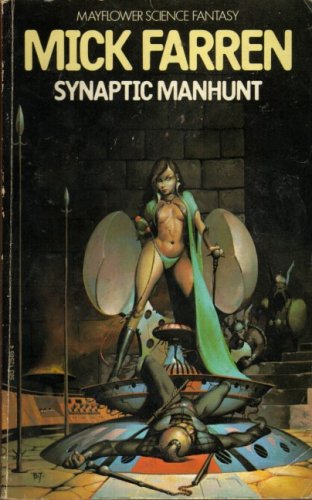
The DNA Cowboys

The DNA Cowboys series by Mick Farren is a group of four novels, The Quest of the DNA Cowboys (1976), Synaptic Manhunt (1976), The Neural Atrocity (1977) and The Last Stand of the DNA Cowboys (1989), the latter forming a coda to the saga. Although sharing the sensibilities and themes of New Wave sf, there is little of the stylistic experimentation that characterized many novels of the period. The books are mistakenly listed in the ISFDB as the "Jeb Stuart Ho" series, although Ho only appears in two of the books (Synaptic Manhunt & The Neural Atrocity).


The eponymous DNA Cowboys are Billy Oblivion, Reave Mekonta, and their on-again, off-again companion The Minstrel Boy, an experienced traveler who has the rare talent of being able to navigate his way through the nothings (as we later learn this is thanks to a lizard brain implant). The nothings are the psychedelic chaos that separates the fragmented human communities that are all that remains of a world where reality has broken down. After some adventures (including being drafted into Sauron's army) Billy and Reave eventually end up in the company of the patrician libertine AA Catto, a woman whose emotional immaturity is reflected in her permanently adolescent body.


Things really pick up in the second and third novels, when the assassin monk Jeb Stuart Ho enters the picture. He's been dispatched by his order to bump off Catto, and he strong-arms Minstrel Boy into acting as his guide. Ho soon runs afoul of the policeman, Bannion, and Catto, Reave in tow, gets wind of his plans as does Billy. The chase is on and it soon becomes clear that the reason Catto is such a danger is that her egomania has become a full-blown Napoleon complex. She's determined to wreak havoc in her mad pursuit of world domination.

Simultaneously with all of this we follow the progress of She/They, a tripartite female entity that holds humanity in little regard.


The fourth book tells a similar tale as the DNA Cowboys, accidentally reunited, reluctantly take a stand against the warlord Vlad Baptiste and his cohorts as he lays waste to the remaining pockets of humanity in the course of his fanatical vendetta against the haughty Metaphysicians.


The DNA Cowboy books are best seen in their context as a part of 1970's pop-culture. Reading them is like watching a Ralph Bakshi movie, full of swirling colors and counter-culture allusions. It's a world where Kwai Chang Caine rubs shoulders with Kojak and Elvis finds himself out of his element. The references range from The Lord of the Rings, TV Westerns, Dune to rock and roll (including Farren's own songs). While competently written, these aren't Farren's best books (David Langford was unsparing in his review of them). The fourth novel finds Farren a more assured writer, and involves a bit of retconning. It also seems to have been written at a time when his fascination with military history was running high. It provides a satisfactory conclusion to the tale of the DNA Cowboys allowing them to find either apotheosis or go out in a blaze of glory. If you want to find out which they choose you'll have to take a hit of cyclatrol and follow the DNA Cowboys yourself.

Friday, November 27, 2009

Darkness and Dawn

Andre Norton's Darkness and Dawn (2003) contains two unrelated but thematically similar novels published in one volume. Both are set in a post-apocalyptic world disfigured by catastrophe in which humanity has been reduced to a pre-industrial existence. They are each rite of passage stories relating how a young protagonist comes to maturity. Yet for all their similarities, each novel treats the topic in a different way and comes to very different conclusions.

The first novel, Daybreak—2250 A.D. (aka Star Man's Son, 1952), introduces us to young Fors of the Puma Clan. Fors and his mountain tribe are descendants of survivors of the Great Blow-up, a nuclear war that wiped out industrial civilization and unleashed mutations hundreds of years ago. Fors himself is just such a mutant, marked by his white hair and ability too see in the dark. The orphaned son of a Star Man, one of the brave and privileged members of the tribe who venture forth to seek the knowledge and relics of the Old Ones, Fors hopes to gain entry into that organization himself. He has already bonded with Lura, one of the giant mutant cats that live among his tribe. But because of the stigma of being a mutant he has little chance of being accepted into the order. So he sets off on his own, determined to retrieve the secrets of the past and prove himself worthy of entrance into Star Hall. He soon befriends Arskane, a black-skinned warrior whose people are descendants of the flying ones who found refuge in the desert after the Last Battle. Together they must survive the threat of both rival tribes, like the nomadic, horse riding Plainsmen, and the Beast-things, vicious, mutant humanoid rats.

The novel unfolds with a straightforward and competent vigor. Norton is a natural storyteller and she sweeps you into the book quickly and keeps the plot moving at just the right pace to ensure that the momentum never lags. The chapters of this book are short to the point of terseness, recalling the clipped delivery of the old pulp magazines. Norton does a good job of depicting tribal societies, especially that of the Plainsman. The characters are conveyed well, with Fors and Arskane being the most detailed. To begin with it is Arskane and his fervent idealism that stands out as Fors is still striving to find himself, but by the novel's climax Fors comes to his own. And while women only feature in the background of the book they aren't just decoration and have an important say in tribal matters. Perhaps the most striking thing is the human dimensions in which the main characters are drawn. Fors and Arskane are not macho action heroes capable of superhuman feats. They spend most of the book wounded and exhausted, making their eventual triumph all the more impressive. And while that triumph may be a trifle pat it makes for a satisfying conclusion to the tale.


The second book is No Night Without Stars (1975). Like the earlier novel the story is set centuries after a catastrophe has destroyed industrial society, but in this case it was not a nuclear war. There was a Dark Time when volcanoes burst forth, continents shook and rent, and the seas alternately racked the land and receded to form new coastlines. While Norton never explains the cataclysm in so many words, it's clear from the clues she gives that some sort of massive celestial body passed near the Earth and the resulting tidal strains caused devastating geological disruptions. Civilization fell and the remnants of humanity reverted to tribalism and sunk into illiterate superstition.

This is the world of Sander, the smith. He has left his tribe, the Mob, after his father died and they refused to recognize him as a fully qualified smith. Accompanied by the huge mutant coyote, Rhinn, he hopes to rediscover the lost secrets of working the hard alloys of the Before People. They come upon a destroyed fishing village that has been laid waste by the Sea Sharks, vicious pirates that prey on the coasts. That night they are confronted by someone they soon learn to be Fanyi, the Shaman of the fishers who was away at the time of the slaughter. With her two large, mutant otters, Kai and Kayi, she has vowed revenge. The two of them soon join forces and set out to find a lost city of the Before People where they hope to discover the knowledge they will need to accomplish their ends.

Although they encounter strange mutants during their odyssey, the greatest threat to them comes from their fellow human beings. There are Traders who have laid claim the the ruins of the Before People and are ready to kill in order to keep others from their finds. Even more menacing are the White Ones, ferocious light-skinned warriors from the north who ride into battle on huge mutant deer. The White Ones raided Sander's Mob when he was a child and he has never forgotten the terror of that fight.

This novel finds Norton a noticeably more assured and mature writer. While she's lost none of her storytelling panache, she brings a more practiced hand to bear on the material. The result is a book with more texture than the earlier work. The only false note struck is the complete lack of any sexual tension between Sander and Fanyi. Despite sometimes sharing cramped sleeping quarters and occasionally stripping off wet cloths in front of one another neither evinces the slightest sexual curiosity about the other. In fact, despite all they go through they never develop any real intimacy, physical or otherwise. This is somewhat understandable on Fanyi's part, as she is a Shaman and therefore a bit aloof form mundane concerns to begin with, but it is a puzzling lack in Sander.

Having these two novels in one volume allows them to be contrasted one against the other. While both evoke a strong sense of loss, of the vanished accomplishments of the destroyed civilization, they each present it very differently. In the first it is humanity's own militarism and folly that has doomed it. It is hoped by some, like Arskane, that people can remake that lost world, but this time learn from their mistakes and outgrow the warlike tenancies that doomed their ancestors. In the second, however, the catastrophe was a natural disaster beyond humanity's ability to avoid or even influence. The world that follows is one where overgrown animals abound, where humanity is dwarfed by nature (and perhaps even the supernatural). The animal's stature is increased even as humanity's figurative stature is decreased. And now the past and it's accomplishments, while initially sought out, are ultimately something to be rejected.

Both of these books are fine accomplishments by Norton. Despite the similarities of general plot each gives the subject matter a distinct and interesting treatment. There is no sense that the second novel is a pastiche of the first, as one might expect. It casts the subject in a different light and draws conclusions that stand in contrast to the earlier work. It takes a talented author to cover the same ground twice and pull it off, but in these two books Andre Norton has achieved just that.

Monday, November 16, 2009

The Unforsaken Hiero

Sterling E. Lanier's novel The Unforsaken Hiero (1983) is as you might expect a sequel to his earlier novel, Hiero's Journey (1973). An adventurous yarn like the first, it's told in the same simple, straightforward prose. The narrative picks up almost immediately where the previous book left off in a short prologue that leads into the main narrative.

Hiero has managed to outwit both the Unclean hordes and the malevolent House. Thanks to Luchare he has the manuals necessary for the Abby to make a computer. But Brother Aldo has other ideas. He tells Hiero he must go south with Luchare to face the Unclean threat there. Brother Aldo will travel north with Gorm and take the manuals to Abbot Demero, who he suddenly reveals is his friend. Hiero doesn't question why he kept this secret until now. He accepts Aldo's plans, hands over the manuals, and heads out to the southern kingdoms.

The tale then leaps forward to Hiero's life in the feudal lands. As Luchare's husband, Hiero is literally being given the royal treatment. He has ingratiated himself with her father, King Danyale, and is now an heir to the throne. The feudal kingdom of D'lwah is very different from the theocratic Metz Republic from whence he hails. Here the church is separate from the state, and he's aghast at their practice of priestly celibacy. He also discovers for the first time members of different faiths, the Mu'amans (Muslims) and the Davids (Jews), though we learn little about them other than that they exist. He has managed to pick up the skill of riding the hoppers, the huge mutant kangaroos that are used as cavalry mounts.

Yet Hiero hasn't been able to get a lead on the Unclean. His only suspects are those who are able to shield their minds from his formidable telepathy, which had increased to superhuman levels in the last book. These are the priest Joseato, and court favorite, Duke Amibale Aeo. There is no evidence of wrong doing on either one's part, and as such mind shields can occur naturally Hiero must wait and watch. But evil plots are underway, and Hiero soon finds himself kidnapped and given a drug which robs him of his psi powers. By a stroke of fortune he escapes his captors and embarks on an odyssey back to the North if only he can survive the perils along the way.

Lanier is an able story teller and this book is a good complement to the previous installment. As in the earlier work he finds occasion to give a convincing account of boating, and later in the book paints a persuasive picture of a massed fighting force. The descriptions of the hopper cavalry are as picturesque as they are implausible. The book suffers from similar flaws as the first as well. The narrative bogs down in exposition at times, and Lanier's reliance on giant animals to populate this future landscape seems uninspired. The manner in which Hieiro's telepathy is restored was also overly convenient if undeniably unconventional.

The characters are again reasonably well drawn, but as the bulk of the novel involves Hiero trekking northward on his own we hear far too little of them. The allies he makes along the way, the Children of the Wind, and the old friend he reunites with in the final chapters stand out in this regard. Hiero behaves in a relatively more priestly manner this time around, saying prayers and orisons that were noticeably lacking from the previous book. We are also given a glimpse inside the councils of the Unclean, but they are little more than stereotyped two-dimensional villains.

And as evil as they are it's hard to stomach the response of Hiero and his allies to them. At one point some Unclean are unceremoniously condemned and killed because they had just killed helpless captives, yet in this book as in the last Hiero himself orders the killing of a helpless prisoner of war. When the forces of the north deliver their first blow against the Unclean it's by shelling the port city of Neeyana despite the absence of any sizable body of enemy troops and without any regard for the civilian population. These are priests that know nothing of mercy, only ruthlessness. Add to this that Hiero is fighting in the name of a patriarchal theocracy and it makes it difficult to sympathize with his cause.

There's also an unnecessary amount of repetition in the story. Several times during his wilderness trek we're assured that Hiero's skills as an outdoorsman are compensating for his lack of psi abilities, as if Lanier recognized he was straining the reader's credulity. And twice during the story we're treated to emotional reunions between Hiero and his trusty mount. And there are strange inconsistencies in Hiero's character. As mentioned earlier he prays regularly, but he no longer applies the face-paints he wore in the previous book, something that isn't even commented on until near the end of the story. And despite his contempt for celibacy among priests when he is later introduced to an noble young priest he instantly and approvingly recognizes him as a celibate. This strange incongruity is never addressed.

There is a sense that Lanier was running out of steam. There was a gap of ten years between the first book and this sequel. The novel ends on a cliff hanger with Hiero preparing to go to Luchare's aid. There are indications that a powerful evil being, the source of the Unclean, is present in the south and must be defeated. A climatic confrontation between Good and Evil is clearly in the offing. But no concluding book was ever written. The trilogy is left incomplete and we can only wonder at the ultimate fate of Hiero and his world.